New policy briefs by a broad range of stakeholders in energy and social policy outline key levers for the EU to improve citizen participation and inclusion in the energy transition.

Brussels, 6 November 2025 – The Green European Foundation and Heinrich-Böll Stiftung EU | Global Dialogue today released three policy briefs calling for the EU to fully grasp the potential of its upcoming initiatives in energy to boost citizen participation in Europe’s energy transition.
Ahead of the EU’s Citizens Energy Package, Grids Package and Affordable Housing Plan, the briefs identify key elements to maximise access to the many benefits of the energy transition for as many Europeans as possible. Key recommendations include:
- A framework for renewable energy project developers to engage with local communities on benefit sharing to accelerate deployment and boost competitiveness.
- Stronger guidance on designing network tariffs that protect consumers and reduce energy poverty.
- A ‘resilience’ approach to housing affordability that promotes renovation by also accounting for the cost of energy efficiency, health impacts and climate adaptability.
Author Etienne Charbit, Réseau Cler, on benefit sharing of renewable energy projects:
'Benefit sharing is a win-win situation - developers and operators engage with local communities impacted by a renewables project, fairly distributing the benefits and in doing so build local support that can improve acceptance and reduce permitting obstacles. It is crucial that the Commission recognises this potential for improving citizen participation, accelerating renewables rollout and boosting competitiveness in the upcoming Citizens Energy Package, with a view to making benefit sharing systematic.'
Author Tom Lewis, Climate Action Network Europe, on fair allocation of network costs: 'Well-designed grid tariffs can reward household flexibility that eases pressure on grids while protecting vulnerable consumers and supporting affordable energy prices. The EU must use its upcoming initiatives to provide guidance and support to enable national regulators to offer flexible and equitable network tariffs.'
Author Emily Bankert, Buildings Performance Institute Europe, on affordable and energy efficient housing: ‘The housing crisis is acute, but the EU must take a long-term perspective on affordability that recognises the cost saving potential of renovating existing buildings into healthy, energy efficient and climate resilient homes. The Affordable Housing Plan should explicitly link affordable housing to the Energy Union’s broader goals of energy security, efficiency, and decarbonisation.’
The publication comes in a context of political pressure to shift focus towards industry and competitiveness amidst ongoing cost of living and housing crises. The briefs are the fruit of six months of co-creation by a Knowledge Community of energy and social policy experts working on how to boost citizen engagement in the energy transition. They complement five policy briefs from the same Knowledge Community published in 2024, on Just Transition Governance, Renovation and renewable heating and cooling, Electricity tariff design, Facilitating energy sharing, and Local transition management.
The full briefs can be found at https://eu.boell.org/en/fair-energy-transition and https://gef.eu/publications/
A conference will be held to launch the briefs on Wednesday 12 November at Townhall Europe (Square de Meeûs 5-6, 1000 Brussels). Register here. Programme here.
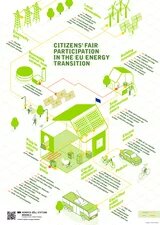
Check out also the new infographic “Citizens' participation in the EU energy transition” by the Heinrich-Böll-Stiftung European Union | Global Dialogue.
For press and media requests, please contact:
- Joan Lanfranco, Head of Communications and Outreach, Heinrich-Böll-Stiftung EU | Global Dialogue, Joan.Lanfranco@eu.boell.org, +32 475 74 16 82
- Matthew Jones, Policy consultant, Green European Foundation, matthew.jones@gef.eu +32 486 67 88 24
The Green European Foundation (GEF) is a European-level political foundation whose mission is to contribute to a lively European sphere of debate and to foster greater citizen involvement in European politics. GEF strives to mainstream discussions on European policies and politics both within and beyond the Green political family. The foundation acts as a laboratory for new ideas and offers cross-border political education and a platform for cooperation and exchange at the European level.
The Heinrich-Böll-Stiftung European Union | Global Dialogue office represents the Heinrich-Böll-Stiftung (the German Green political foundation) vis-à-vis European and international institutions, associations, non-governmental organisations and media based in Brussels. The office is a main point of contact for individuals, groups and organisations from around the world interested in EU politics and policies. The future of the European project and the role of the European Union in the world are at the centre of our activities and efforts.